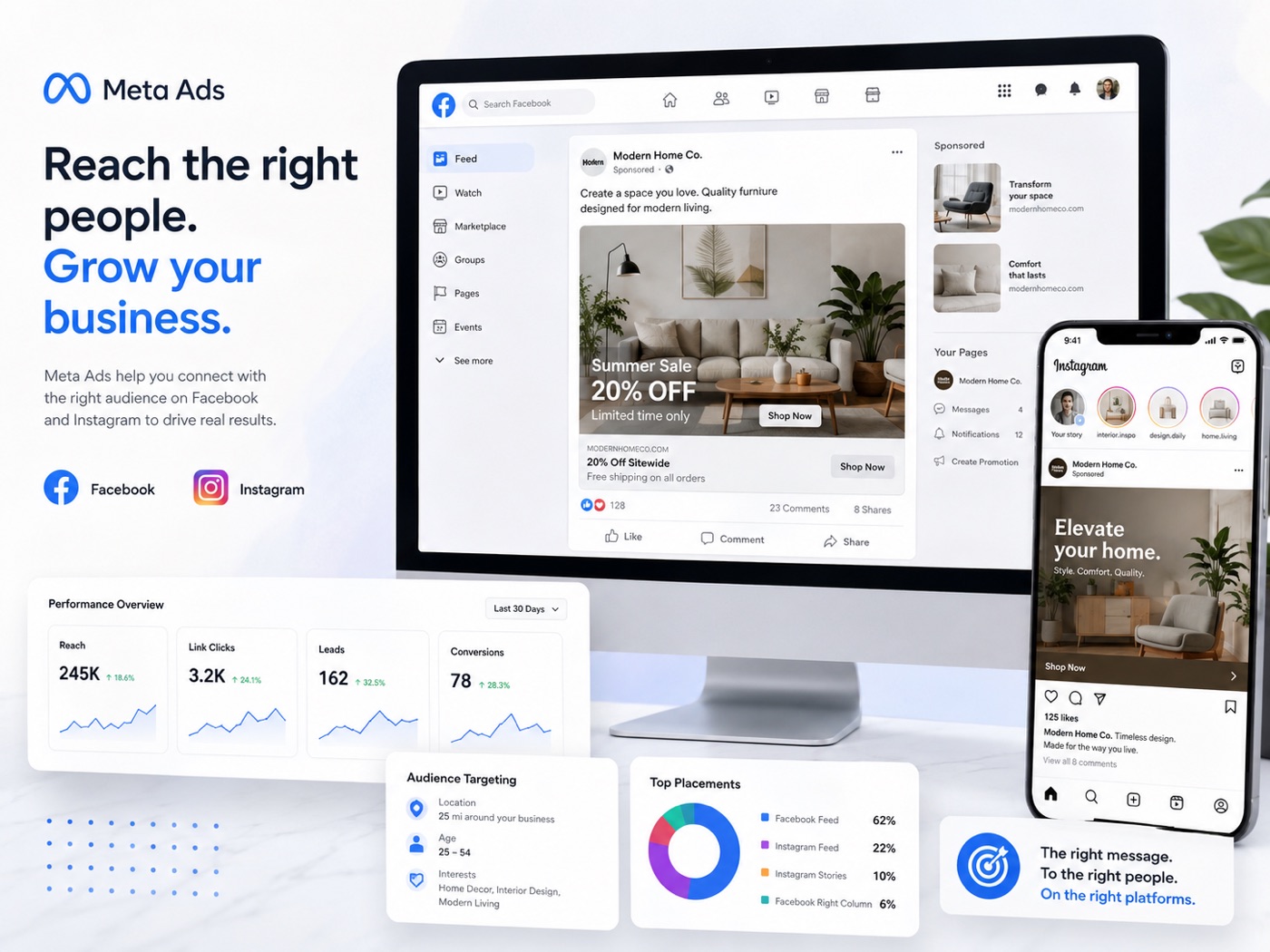
Why Most Small Businesses Lose Money on Facebook & Instagram
Many local business owners try running Meta ads themselves, or hire cheap agencies that send monthly reports bragging about thousands of impressions, high reach, and cheap clicks.
Here is the hard business truth: vanity metrics do not pay your payroll. You cannot take a thumbs-up to the bank. If your ads are getting thousands of views but the phone isn’t ringing and form submissions are zero, the campaign is structurally failing.
Social advertising is not a branding exercise for local service providers—it’s a direct response channel. It requires interrupting the scroll within two seconds, establishing instant trust, and driving immediate action.
The Mechanics of Meta Ads: Interruptive Intent vs. Search Intent
To understand why Facebook and Instagram ads work so well for local service businesses, you have to understand the difference between search intent and interruptive intent.
- Google Ads captures people already raising their hands — someone typing “emergency HVAC repair near me” is looking for an immediate solution.
- Meta Ads operates differently. Nobody opens Instagram to look for a kitchen renovator or a wedding photographer. They open it to browse stories, watch reels, and see what friends are doing.
This is where interruptive intent works. Using Meta’s demographic, behavioural, and geographic data, we place your business in front of local homeowners before they start actively searching. If someone has been thinking about a backyard makeover or a basement remodel, the ad stops the scroll and plants the seed long before they ever open Google.
The Berankly Social Advertising Blueprint
We treat Meta ads as a predictable, mathematical system. Every campaign we launch is built on three non-negotiable pillars.
- Pattern-interrupt creative. Users scroll faster than you think. If your ad looks like a corporate stock photo, it’s invisible. We design native, authentic visual frameworks and punchy copy hooks that stop the scroll and instantly communicate why a local buyer should choose you.
- Hyper-local geographic fencing. National brands can afford broad regions. A local contractor, clinic, or restaurant cannot. We lock the audience down with precise radius parameters and postal code exclusions around your location or service zone, so not a dollar leaks outside your territory.
- Frictionless conversion architecture. Sending expensive paid social traffic to a slow, confusing homepage wastes money. We pair campaigns with fast, minimalist landing pages or native Instant Forms that capture name, phone, and intent in two taps.
The Full-Funnel Social Strategy: Prospecting, Retargeting, and Lookalikes
Amateur advertisers launch a single ad and hope people buy immediately. Professional management requires a multi-tiered funnel.
- Top of funnelProspecting & local fencing
We target cold audiences within a precise radius or specific postal codes—Kanata, Nepean, the Glebe. Pattern-interrupt creative like real project transformations, short video walkthroughs, or clear problem-solving angles introduces your brand to local buyers.
- Middle of funnelWebsite retargeting
Roughly 98% of people who visit your website or landing page leave without filling out a quote form. Retargeting is the safety net—subtle, relevant reminders across their Instagram and Facebook feeds days later, turning hesitant browsers into booked consultations.
- Bottom of funnelLookalike modelling
Once the campaign has collected enough data, we instruct Meta’s algorithm to analyse your past leads and build lookalike audiences—finding thousands of others in your region who share the same behaviour and buying patterns as your best clients.
The Technical Backbone: Meta Pixel, CAPI, and iOS 14+ Resilience
Since Apple’s privacy updates in iOS 14.5, standard browser-based tracking—the old Meta Pixel—has lost up to 30% of its data accuracy. If an agency relies only on an out-of-the-box Pixel installation, your ads are flying blind and Meta’s algorithm is optimising on incomplete data.
We implement a more resilient tracking architecture:
- Meta Conversions API (CAPI). We connect your website server directly to Meta’s server, bypassing browser restrictions, ad blockers, and cookie blockades, so every call, form submission, and lead is accurately fed back into the ad account.
- Clean event optimisation. We optimise for high-intent actions—lead form submissions, click-to-call—rather than cheap clicks. That forces Meta’s algorithm to hunt for real buyers, bringing your cost per lead down month over month.
Frequently Asked Questions
It depends on buying intent. Google Ads captures high-intent searchers looking for a solution right now—“emergency roof repair.” Meta operates on interruptive intent, reaching people by demographics, behaviour, and interests before they start searching. Running both—Google for immediate cash flow, Meta for continuous demand—creates the strongest pipeline. There’s a fuller comparison in SEO vs Google Ads.
Boosting hands money to a button designed to spend your budget fast with almost no control. Professional management runs inside Meta Ads Manager, which allows strict geographic fencing, custom pixel event tracking, audience exclusions, and proper A/B split testing—none of which the boost button gives you.
Your ad budget goes directly to Facebook and Instagram. For local service businesses, starting at $20 to $50 a day—roughly $600 to $1,500 a month—is usually enough to gain traction, feed the algorithm clean data, and produce a profitable return.
Most people who visit your website for the first time leave without converting. Retargeting is the safety net: it places a subtle ad in front of those past visitors while they browse Instagram or Facebook days later, reminding them to finish booking or calling. It’s often the highest-return campaign in an account.
Unlike SEO, which takes months of authority building, Meta Ads can go live within 48 hours. The first 14 to 30 days function as the algorithm’s learning phase, where the system tests creative variations and audience segments to stabilise your cost per lead.