What Local SEO Actually Is (And Why It Requires a Different Strategy)
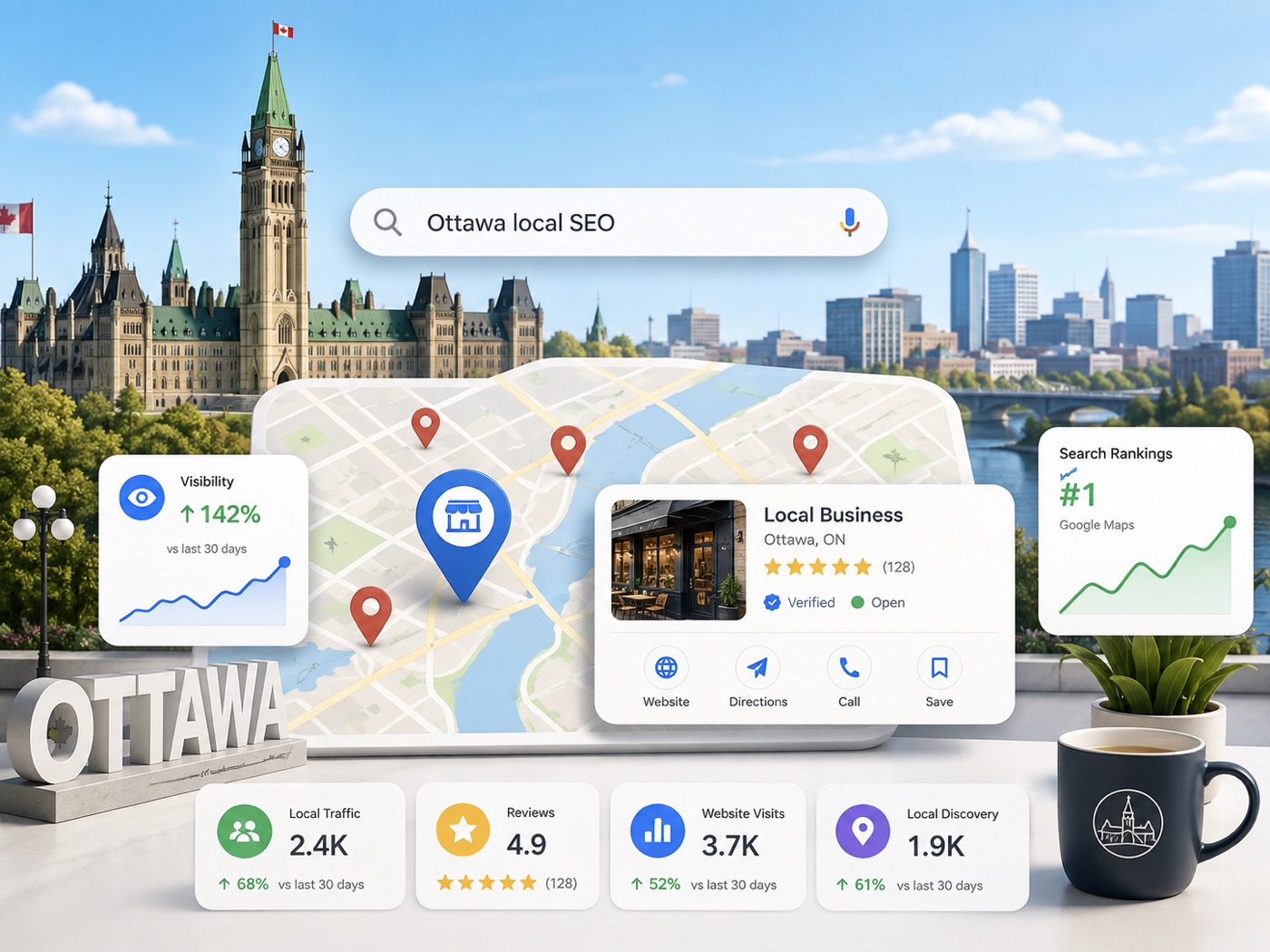
Local SEO isn’t just about ranking on Google; it’s about dominating the exact places local buyers actually look—the Google Maps 3-Pack and “near me” search results. While it overlaps with traditional organic SEO, local search relies on a unique algorithmic trio: relevance (how well your profile matches the query), distance (your proximity to the searcher), and prominence (your overall local authority).
Treating local search as an afterthought to a national SEO strategy leaves massive revenue on the table. We engineer all three pillars simultaneously to put your business in front of customers with immediate buying intent.
Why the Map Pack Is Your Most Valuable Digital Real Estate
For service-area businesses and physical storefronts, the Google Map Pack sits directly above standard organic listings. It captures the vast majority of clicks for high-intent local queries.
When a customer searches for an “emergency plumber near me” or a “dentist in Ottawa,” they aren’t just browsing—they are ready to buy, usually within hours. Because the searcher is so close to a purchasing decision, conversion rates are dramatically higher. Dominating the Map Pack for your core services delivers the highest ROI of any digital marketing channel. We focus on the metrics that matter: making your phone ring.
Google Business Profile (GBP): Your Most Important Local Asset
For the majority of local businesses, a fully optimized Google Business Profile (formerly Google My Business) generates more direct leads than the website itself. Optimizing it is the absolute highest-leverage move in any local SEO campaign.
We don’t just “set it and forget it.” We meticulously optimize every field that influences rankings: primary and secondary categories, service definitions, attributes, photos, and Q&A. Because Google heavily rewards active profiles, we treat your GBP as a living asset. We continually monitor it, update it, and protect it from malicious competitor edits that can quietly knock a business out of the Map Pack overnight.
Review Velocity, Recency, and Reputation Management
Online reviews are one of the strongest local ranking factors and the ultimate deciding factor for a buyer. However, Google’s algorithm looks far beyond your total star count. It evaluates recency, review velocity (a steady, authentic flow of reviews rather than a sudden, unnatural spike), keyword-rich content within the reviews, and your response rate.
We implement a structured, automated review-acquisition workflow tailored to your business operations. Furthermore, we establish a disciplined response strategy so every review—positive or negative—is managed professionally, compounding your local authority month over month.
Citations, NAP Consistency, and Local Link Building
Citations are mentions of your business’s Name, Address, and Phone number (NAP) across online directories. They establish the baseline trust Google needs to take your local presence seriously. Even minor inconsistencies in your NAP data across the web can quietly suppress your rankings. We rigorously build, audit, and clean up your citations across major directories to ensure flawless consistency.
Beyond basic citations, we help you earn the local links that competitors find hardest to replicate—such as community organizations, local business associations, and neighbourhood publications. These geographically grounded backlinks are pure gold for Google’s local algorithm.
On-Site Geographic Relevance and Local Content
Your website must technically validate the location claims made on your Google Business Profile. Google actively penalizes thin, duplicate “doorway pages” designed just to spam different city names.
Instead, we build dedicated, substantive service-area pages (City Pages) with genuine local relevance. We intersect local SEO with smart content architecture—creating neighbourhood guides, local case studies, and geographically relevant content. Every page is strategically interlinked to your core commercial pages, ensuring that your local content lifts your overall website authority without triggering duplicate content penalties.
Frequently asked questions
Regular SEO works on national or global visibility. Local SEO is tied to a geographic area and runs on a different set of signals—proximity, prominence, and relevance—anchored by your Google Business Profile and local citations rather than by your site alone.
For plumbers, HVAC technicians, restaurants, clinics, and medspas it’s usually the highest-return channel available. Someone searching “roofing repair near me” is often hiring within 24 hours. If you’re not in the three-pack, a competitor takes that job.
It depends on how competitive your market is. But fixing NAP errors, properly optimising the profile, and starting a steady review flow tends to produce visible movement in visibility and calls within the first 30 to 60 days.
Large agencies commonly charge $1,500–$3,000+ a month, with a lot of that covering overhead. Our packages run $600 to $2,400 depending on scope, with the work and the price stated up front—no setup fees, no minimum term.
The algorithm uses many signals, but a properly optimised and actively managed Google Business Profile carries more weight than anything else for map pack rankings. It’s also the cheapest thing to fix.
Yes, but only if they’re done properly. Google penalises thin, duplicated doorway pages. Each area page needs genuinely local content—real specifics about that community—not the same paragraph with the place name swapped.
More than most owners expect, and not just the total count. Google weighs how steadily reviews arrive, how recent they are, what the text actually says, and whether you reply. Ten reviews over ten months beats ten in one week.
Yes. If you’re a service-area business—an electrician, cleaner, or contractor who works at the customer’s location—you can hide your address and define service areas instead. Google ranks you on those areas plus the geographic relevance of your site.
A citation is any online mention of your business name, address, and phone number—Yelp, YellowPages, a chamber of commerce listing. NAP consistency means those details match exactly everywhere. Mismatches quietly suppress rankings, and they’re very common.
AI answers lean on structured data and consistent entity information. A well-maintained profile, steady reviews, and pages that answer specific local questions give these systems what they need to cite you. The work overlaps almost entirely with normal local SEO.